Sri Lanka is home to numerous historical sites, but few are as captivating, well-preserved, and spiritually significant as the Dambulla Cave Temple. Located in the central part of the island, this extensive temple complex offers a profound look into the country’s rich Buddhist heritage and incredible artistic history. Also widely known as the Golden Temple of Dambulla, this remarkable location was designated a UNESCO World Heritage site in 1991. The site is a popular and essential destination for visitors wanting to understand the deep cultural roots of Sri Lanka, and it forms a crucial part of the island’s renowned Cultural Triangle.
For those planning a trip to Sri Lanka, navigating the public transportation network or negotiating daily rates with local drivers can sometimes be challenging, unpredictable, and time-consuming. This is where planning your itinerary with a reliable travel partner makes a significant difference. When you choose to travel with Ceylon NY Holiday Tours, you can focus entirely on enjoying these incredible historical sites. We handle all the intricate logistics, ensuring you arrive comfortably, safely, and at the best possible times to avoid the largest crowds and the intense midday heat.
A Brief History of Dambulla Cave Temple
The history of the Dambulla Cave Temple spans over twenty-two centuries, making it one of the oldest functioning temple complexes in the world. Its origins trace back to the first century BC, a tumultuous time in Sri Lankan history. During this period, King Valagamba (also known in historical texts as Vattagamani Abhaya) was driven out of his kingdom in Anuradhapura by South Indian invaders. Seeking safety and a place to regroup, the king fled south and found refuge in the natural caves of Dambulla. He lived in exile within these caves for fourteen long years, protected and supported by the local Buddhist monks.
When King Valagamba eventually defeated the invaders and regained his throne in Anuradhapura, he returned to Dambulla to show his immense gratitude. He ordered the caves to be expanded and transformed into magnificent rock temples. This initial construction was just the beginning of a long and enduring legacy of royal patronage. Over the centuries, subsequent Sri Lankan rulers continued to add to the complex, renovating existing structures, adding new statues, and creating new shrines within the massive rock face.
In the twelfth century, King Nissanka Malla is said to have gilded many of the statues, earning the site the enduring moniker “Golden Rock Temple.” Later, during the eighteenth century, the Kandyan kings made significant additions. They restored the ancient artwork and commissioned expansive new murals that reflect the distinct Kandyan artistic style of the era. Today, the complex you see is a remarkable amalgamation of different historical eras, showcasing the continuous evolution of Sri Lankan art, architecture, and religious devotion over two millennia.
What to Expect When You Visit
The Dambulla Cave Temple is situated on a massive granite outcrop that towers approximately 160 meters over the surrounding plains. To reach the historical caves, visitors must climb a series of sloping stone steps and paved pathways. The ascent takes roughly twenty to thirty minutes depending on your physical fitness and pace. While the climb is not overly strenuous, it involves a fair amount of walking uphill, so it is best tackled early in the morning or later in the afternoon to avoid the intense tropical sun.
As you make your way up the path, taking breaks to catch your breath, you will likely encounter troops of toque macaques. These monkeys are accustomed to human presence and can be quite entertaining to watch as they play among the trees and rocks. However, it is important to remember that they are wild animals. It is highly recommended not to feed them and to keep any food items, water bottles, or loose belongings securely tucked away in your bag to avoid any unwanted attention.
Once you reach the top, the effort of the climb is well rewarded. The broad terrace in front of the caves offers spectacular panoramic views of the flat, green landscape below. On a clear, sunny day, you can even spot the distinctive square shape of the Sigiriya Rock Fortress rising dramatically from the dense forest in the distance.
The Modern Golden Temple at the Base
Before you begin the climb to the historical caves, you will arrive at the modern Golden Temple located at the very base of the rock. Completed in the year 2000 with the help of international donations, this structure features a massive, thirty-meter-tall golden statue of the Buddha seated in the Dhamma Chakra posture. The large building situated directly underneath the statue houses a small museum, though the primary attraction for the vast majority of visitors remains the ancient caves situated at the top of the hill. Your driver from Ceylon NY Holiday Tours will typically drop you off near this entrance, where you can easily purchase your entrance tickets before beginning the ascent.
Inside the Five Main Caves
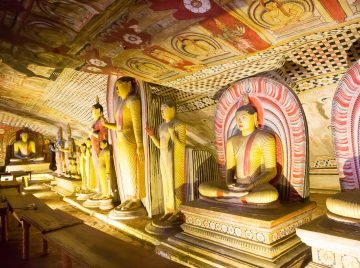
The Dambulla Cave Temple complex consists of over eighty documented caves in the surrounding area, but the main attractions are heavily concentrated within five primary caves. These five caves contain a total of 153 Buddha statues, three statues of Sri Lankan kings, and four statues of Hindu deities. The walls and ceilings are covered with intricate murals depicting scenes from the Buddha’s life, totaling an estimated 2,100 square meters of beautifully painted surfaces.
Cave 1: Devaraja Viharaya (Cave of the Divine King)
The first cave you will encounter, known as the Devaraja Viharaya, is relatively small but houses one of the most impressive statues in the entire complex: a massive fourteen-meter reclining Buddha carved directly out of the solid rock wall. The statue portrays the Buddha in his final moments before attaining Parinirvana. The details of the rock carving are remarkable, particularly the painted soles of the Buddha’s feet, which are decorated with traditional floral patterns and symbols.
Beside the reclining Buddha, you will find a wooden statue of the Hindu god Vishnu, which is believed to have been placed there during the reign of King Valagamba. The presence of Hindu deities within a Buddhist temple is a common feature in Sri Lanka, reflecting the historical blending and peaceful coexistence of these two religious traditions on the island. The murals in this particular cave have faded considerably over time, giving the space an atmosphere of deep, quiet antiquity.
Cave 2: Maharaja Viharaya (Cave of the Great Kings)
The second cave, Maharaja Viharaya, is the largest and arguably the most spectacular of all the caves at Dambulla. It measures over fifty meters in length, twenty-three meters in width, and up to seven meters in height at its highest point. The cave is named after two large statues of great Sri Lankan kings found within its walls: King Valagamba, who founded the temple, and King Nissanka Malla, who was responsible for gilding many of the original statues.
This cavernous, awe-inspiring space contains over fifty Buddha statues in various traditional postures—seated, standing, and reclining. The ceiling is completely covered in vibrant murals that trace the historical lineage of Buddhism in Sri Lanka and depict significant events from the Buddha’s life, such as his temptation by the demon Mara. The artwork follows the contours of the rock face perfectly.
One of the most fascinating and revered features of the Maharaja Viharaya is a small, enclosed area where water constantly drips from a crack in the ceiling. Curiously, this water appears to flow upwards against the rock surface before dripping down into a designated vessel. The water is considered highly sacred and is used exclusively for temple rituals. The exact source of this water remains a natural mystery, adding to the spiritual significance of the site.
Cave 3: Maha Alut Viharaya (Great New Monastery)
The third cave was transformed from a simple storeroom into a magnificent temple during the eighteenth century by King Kirti Sri Rajasinha, one of the last kings of Kandy. This cave is an excellent showcase of the distinct Kandyan style of art and architecture. The expansive space contains over fifty seated and standing Buddha statues carved from rock, along with a prominent, life-sized statue of King Kirti Sri Rajasinha himself, honoring his contribution to the temple.
The murals in this cave are particularly well-preserved, featuring bright, vibrant colors and detailed depictions of the Buddha and various celestial beings. The ceiling paintings are so meticulously executed that they create the convincing illusion of a fabric canopy draped tightly across the uneven rock surface, demonstrating the exceptionally high level of skill possessed by the Kandyan artists of that era.
Cave 4: Pachchima Viharaya (Western Temple)
Despite its name, the Pachchima Viharaya is no longer the westernmost cave, as another cave was added to the complex later on. This cave is smaller than the second and third caves, creating a much more intimate and quiet atmosphere. It features a beautifully carved seated Buddha situated under an elaborate makara torana, which is a traditional archway decorated with mythical creatures.
In the center of the cave stands a small stupa, which was once believed to contain the jewelry of Queen Somawathi, a prominent historical figure. The statues and artwork here are consistent with the artistic styles seen in the other caves, focusing primarily on themes of meditation, contemplation, and inner peace.
Cave 5: Devana Alut Viharaya (Second New Shrine)
The fifth and final main cave is the newest addition to the Dambulla complex. It was formerly used as a practical storehouse before being formally converted into a shrine in the early twentieth century. While it is the most modern of the caves, it still features impressive statues, including a large reclining Buddha that dominates the space. The materials used for the statues in this cave incorporate brick and plaster in addition to the solid rock, differentiating it slightly from the older, rock-hewn sections of the temple.
Planning Your Trip to Dambulla
Visiting the Dambulla Cave Temple requires some basic preparation to ensure a comfortable and respectful experience. Because it is a highly sacred religious site, all visitors must adhere to a strict dress code. Shoulders and knees must be completely covered for both men and women. Loose, breathable clothing made of cotton or linen is best for staying comfortable in the warm Sri Lankan climate. You will also be required to remove your shoes and hats before entering the temple compound at the top of the rock. The paved stone terrace can become very hot in the sun, so bringing a pair of thick socks to walk around in is highly recommended.
The absolute best time of day to visit is early in the morning, shortly after the site opens, or late in the afternoon. During these times, the ambient temperature is much more pleasant for climbing the numerous steps, the lighting is excellent for photography, and the crowds are generally smaller.
Arranging your visit independently can involve coordinating multiple buses, negotiating with local tuk-tuks, and navigating ticket counters on your own. When you book your tour with Ceylon NY Holiday Tours, we eliminate all this friction and uncertainty. We provide comfortable, air-conditioned transportation directly to the site, advise you on the absolute best timing for your visit, and ensure you are fully prepared for the cultural requirements of the temple. Our goal is to provide a seamless, entirely stress-free experience so you can focus solely on the history and beauty of the location.
Why Choose Ceylon NY Holiday Tours for Your Cultural Triangle Experience
Traveling through Sri Lanka’s famous Cultural Triangle is an unforgettable experience, but the logistics of moving smoothly between major historical sites like Dambulla, Sigiriya, and Polonnaruwa can be demanding for an independent traveler. Traffic conditions, varying road qualities, and the challenge of coordinating local transport can quickly lead to travel fatigue and wasted time.
By choosing Ceylon NY Holiday Tours, you are opting for unparalleled convenience, safety, and local expertise. Our professional, friendly drivers are highly experienced in navigating Sri Lankan roads, ensuring you travel securely and comfortably between every destination. We thoughtfully design itineraries that maximize your time without ever making you feel rushed or exhausted. Instead of worrying about bus schedules, taxi fares, and complex directions, you can sit back, relax, and enjoy the stunning Sri Lankan countryside from the comfort of our modern vehicles. We pride ourselves on offering a professional, reliable service that turns a good holiday into an extraordinary, hassle-free adventure.
Get in Touch
Ready to explore the ancient wonders of the Dambulla Cave Temple and the rest of beautiful Sri Lanka? Let us help you plan the perfect itinerary tailored exactly to your preferences and schedule.
Ceylon NY Holiday Tours
Address: 187/B/2, Ranaviru Mawatha, Halloluwa, Kandy
WhatsApp: 0740224243